Don't Dream It, Be It
based on Matthew 16:21–28, with Romans 12:9–21
This was a heavy week. Dolly Parton died. Tim Curry died. Yayoi Kusama died. And alongside them, so many others (known and unknown) who moved from this life into whatever comes next. It is the kind of week that makes the world feel a little less bright, a little less strange, maybe a little less willing to sing loudly in public. And then the lectionary hands us Matthew 16:21–28 (Jesus pressing his disciples toward the cross, alongside Paul's insistence in Romans 12 that we overcome evil not with more evil, but with good). The timing is not lost on me. This sermon is about why that is not a theoretical claim. It is an invitation to keep our Christianity in our bodies.
We Practice Before We Understand
Violence only leads to violence.
Hatred only leads to hate.
Violence only leads to violence.
Hatred only leads to hate.
Only love, only love, only love leads to love — only love.
Spoken by Dr. Martin Luther King, Jr. — composed into a melody we’ve sung at University Lutheran over a season or two, the lyrics to this song are simple to sing, to some degree. It is much harder to trust those words. Harder still to practice them.
But that is how being Christian can work. We do not wait until we perfectly understand love before we bodily practice. We practice love (and keep practicing it) until it begins to reshape us. We sing the truth before we can completely live the truth. We return to it when we have failed. We must keep repeating the work, in our bodies, allowing it to become the way we move through the world.
Last week, I mentioned the idea that maybe, just maybe, Jesus was and is looking for us to recognize how ridiculously powerful we humans at large are. This week, I think Jesus (and Paul, in our Romans excerpt) are looking to get us to notice that it is our bodies wherein the power, and the real understanding, are alive and bring us to fullness of life.
Christianity is not meant to be primarily an intellectual pursuit of beliefs affirmed. We cannot think our way into being the Body of Christ. We cannot study love enough that we become love. We cannot agree with Jesus enough that we become followers of Jesus’ Way.
We learn to be Christian by practicing Christianity: with our bodies, our voices, our money, our time, our courage, our habits, and our relationships. We learn love by loving.
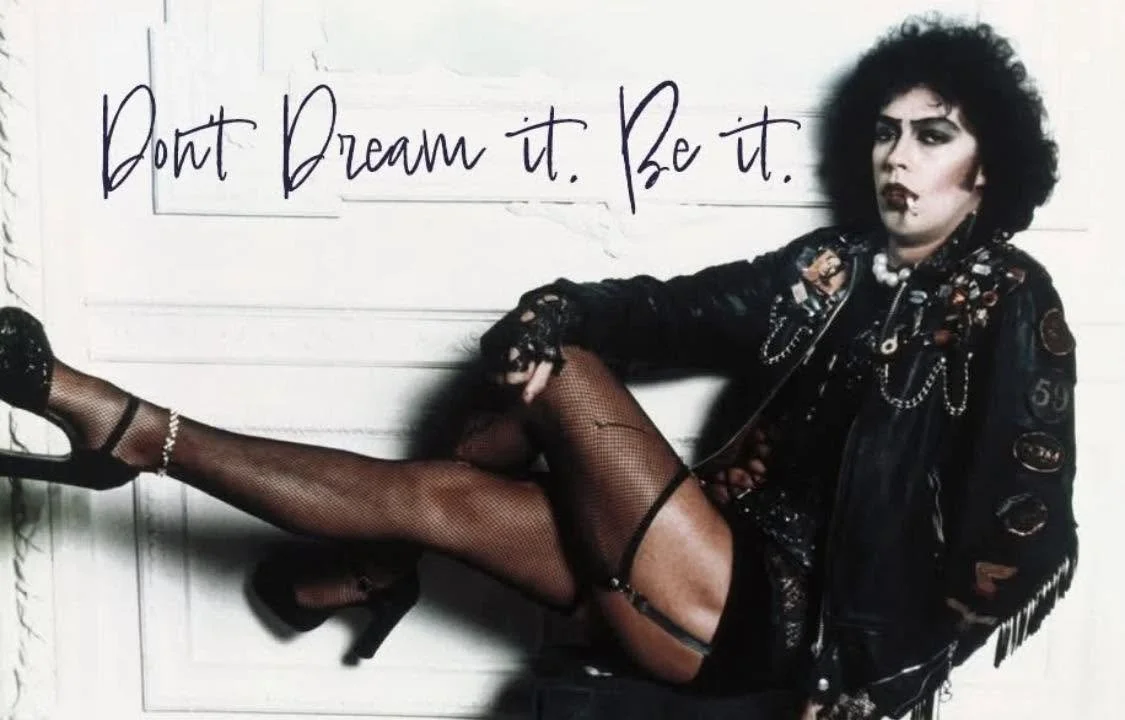
maybe we should try “Dont dream it, take up your cross and be it” ?
Anyone familiar with the Rocky Horror Picture Show? "Don't dream it, be it" — written by Richard O'Brien, sung iconically by Tim Curry — those words land so close to the Gospel today we could almost ask whether the Holy Spirit is playing a solid drag-inspired joke on us. Not because our faith is about individual self-invention, but because living in the way of Jesus is not an intellectual dream we conjure and admire from a distance. We can’t just dream it… we need to go and BE it.
Jesus calls it taking up the cross. Paul calls it overcoming evil with good. Neither are theories. Both are faithful living practices that require us to put our bodies into the effort.
And every time we choose not to return cruelty for cruelty, we're practicing with our bodies. Every time we speak hard truths with honesty, without seeking to humiliate someone, we're practicing with our bodies. Every time we stand beside a vulnerable person so that they might be given more room to speak up and determine what they need, or when we set a healthy boundary, or actively correct a lie that's been socialized into us, or opt to share what we have, or go out of our way to make room for the stranger whose needs don't align with ours, or begin again after failure — every one of these — we are doing Christianity. We are not dreaming it, but being it.
We will not do it perfectly. But we practice anyway, because violence only leads to violence, hatred only leads to hate, and only love leads to love.
Permission to Be Too Much
This week is a week of grief for many. Dolly Parton has died. Tim Curry has died. Yayoi Kusama has died. Three iconic artists. And it feels, perhaps, like the world has become a little less bright, a little less strange, maybe a little less willing to sing loudly in public.
They were each very different people. They had resources many people do not have, and though I would argue that their sheer tenacity made each of them a saint, we needn't make them out like they were naught but perfection. Each, in their God-given way, offered people a living example (perhaps even permission, in some cases) to choose and actively be love over the violent and hatred-filled options of the world.
Dolly Parton had a way of making generosity visible. She made joy visible. She built a public life full of sparkle, humor, tenderness, willingness to acknowledge harm done and change course with honesety and integrity. And she did it in a culture that is so often suspicious of all of those things, and so willing to hyper focus on her appearance over literally everything else she physically did with her body. She did not pretend that life was easy. Her songs knew about longing and poverty and difficult love. And she kept insisting that tenderness was not foolishness, and that compassion was never weakness, and that trying was better than doing nothing. She held herself to high standards of not just dreaming love, but being love, while also finding pathways for others to be able to love more, too.
And Tim Curry, icon in so many places, especially the famed cult classic Rocky Horror Picture Show, helped create a space where being overtly strange, overtly queer, loud, generally socially seen as too much was simply more space for delight instead of shame. For generations of people, Rocky Horror has been a doorway to community, care, and love. While some may find this ridiculous, like I said earlier—- I genuinely think the Holy Spirit hid some core Gospel truth in Richard O'Brien's lyrics sung so iconnically by Curry: "Don't dream it, be it."
It’s not, of course, a formal Christian creed. But it may be more Christian than some of our Christian creeds. We just can't try to brain our way through these Christian things. We need to actually live it. A Luther parallel might be: sin boldly. And Jesus's way of drawing us to the same reality: "Take up your cross and follow me."
And, I think like Curry and Parton and Kusama illustrated in their own lives- “take up your cross and follow me” is not an invitation to chase suffering. It is not an instruction to let people hurt us. It is not a command for people who are already oppressed to make themselves more available to abuse. It is an invitation to not dream about what's possible, but to be people who shape their lives via love, rather than fear. To live that love even when it is inconvenient, even when it costs us something, even when the world tells us there are in fact easier ways.
And there may be joy in that work. There may be laughter, friendship, music, costume, celebration, and the relief of being fully seen. There may also be grief, conflict, exhaustion, uncertainty, and fear. Often, there is all of it mixed together. That is what it is to carry a cross: not a single mood, not a permanent misery, but a commitment. A way of moving through the world. A refusal to let fear make the decisions.
Get Behind Me
A hefty dose of the world we live in goes with the “dont dream it, be it” carrying of our crosses… in today's Gospel, Jesus begins to tell his disciples what lies ahead: rejection, suffering, death. And Peter reacts as many of us would. Peter says, in effect, "Absolutely not. This cannot happen to you." Peter loves Jesus. Peter is not trying to be cruel. He wants to protect his friend. He wants to prevent pain. Just like any one of us would want to do.
But Jesus turns and says, "Get behind me, accuser." (or, “Get behind me, Satan” as many translations go)
It is a startling response. Why so sharp? Especially since Jesus just told his guy Peter last week that he's the cornerstone of the church! He gets the keys, according to Jesus.
The challenge is, Peter is trying to pull Jesus away from the path of love and into the logic of control and domination. Peter is still imagining safety on the terms of hatred and violence as brought to us via Rome: avoid any avoidable suffering; preserve the powerful person in our midst; find a way to win more control and overturn those who are actively harming us. Peter does not see that the systems capable of crucifying Jesus are not going to be changed by Jesus or anyone else making themselves fit into those systems — by being as big, as strong, and seeking to overturn them via their own mechanisms of violence brought back at them.
And here is the hardest part: Peter probably has no clue that he is inadvertently supporting those systems with his "oh no, not you, Jesus!" That is how domination works. It does not walk into the room with a clear label and say “Hi! I’m here to mainpulate and control you, to confuse your values and do harm.” It announces itself as logical, or even common sense, most efficient, or sometimes even cleverness. It tells us that this is simply how the world works. It tells us that our bodies are dangerous and not to be trusted (brains somehow being not part of our body- we’re told to separate those out in some way and, after that separating practice, consider them more trustworthy than the intelligence of our complete bodies?). It tells us that racism is average, so complex it’s impossible to dismantle or engage in repair, misogyny is inevitable, poverty is a personal failure, queer and trans people are a threat to families, disabled bodies are a burden, immigrants are a problem, and that we must accept and return the violence and hatred of the world in order to protect ourselves.
It trains us to become what philosopher Michel Foucault called docile bodies. Bodies that obey, bodies that intuitively avoid certain questions, bodies that do not resist for fear of suffering, bodies that are always on edge about what kinds of space we can or can’t occupy for fear of some seemingly unnameable “them” who are watching and threatening. (Foucault's concept comes from his 1975 work Discipline and Punish, his analysis of how power doesn't just repress bodies but actually produces them: making them useful, compliant, self-regulating. Worth a read, honestly.)
And sometimes, these powerful mechanisms that exert control and dominance even use religion to do their work. They’ll takes Jesus' words about losing one's life and twist them into an instruction to become lass than who and what our holy bodies are. We’re pushed to opt to be quieter, less visible, less honest, less alive. To encourage certain people (like women, especially women of color) to pour themselves out, and other people to simply endure what God does not actually ask them to endure. It asks the harmed to remain available to harm for the comfort of those who are doing the harm.
But … that is not what these words are about. Jesus does not become a docile body in a world that wants him to adhere to the norms and be that controlled, compliant body. He does not cooperate with the powers that demand his obedience. He does not become less loving in order to become more acceptable. He does not abandon the people at the edges of society to gain more power and "change things from the inside." He does not make peace with violence in exchange for a theoretically easier life for himself or others.
Jesus refuses all of it, and forges a lived-example different way, bringing his besties the Disciples along with him so they can live it, too. And that refusal is costly. A world built on violence has trouble tolerating someone who simply and persistently loves. A world built on hatred finds someone who insists on love to be downright threatening. That person is someone who cannot be bought, frightened, diminished, or recruited into cruelty.
Overcoming Evil with Good
So Jesus refuses to fight violence with violence. He knows that violence only leads to violence. Hatred only leads to hate.
This is what Paul means when he says, "Do not be overcome by evil, but overcome evil with good." (Which was written, by the way, before the Gospel of Matthew was written — Paul's letters predate the Gospels, something worth sitting with when we read them side by side like this.)
Paul is not asking us to be passive, either. He is also saying, in his own way, "Don't dream it, be it." Keep going, keep resisting the injustice, minimize the harm, get out of situations where you and others are being abused. Because Love Incarnate showed us clearly (that’s Jesus, by the way): Love tells the truth. Love sets boundaries. Love stands with the vulnerable. Love interrupts violence. Love sometimes walks away. Love says no. But love does not become what it hates.
And that is the hard, holy work of the way of Jesus, it’s the hard holy work of “Dont dream it, be it." Resisting evil without allowing evil to make a home in us. Facing violence without reproducing violence. Insisting on freedom without becoming another person's jailer. And recognizing that we won't do this by just thinking about it. We'll do this because we quite literally throw our bodies into practicing these very things. We elect to take up our various crosses because we’re not just dreaming it, we’re choosing to BE it.
Exactly as We Are
Jesus calls us to let go of the small, frightened selves that have been coaxed into believing that control is safety and dancing with domination is strength. Thus, “get behind me, Accuser” being his response to Peter.
We are asked not to be smaller, but to be exactly as we are in our holy, made in the image of God bodies, in all of our holy, beautiful, God-given differences.
Exactly as we are enough to make room for people unlike us. As we are enough to hold grief without turning it into bitterness. Exactly as we are enough to recognize when we are being pulled into the shitty domineering patterns of fear and control. As we are enough to resist violence and hatred without becoming violence and hatred incarnate, ourselves.
Though I’d love it if things worked out this way, there likely won't be a day when we leave church checking a box, definitively proving that we did it—we found the way to love and only love (though if we do, wouldn't that be terrific?! Please tell Bishop Jeff, for me!). But what I hope, for all of us, is that we come here and go back out into the world each week reminded, and renewed for the cross-bearing, don’t dream it be it days ahead:
Violence only leads to violence.
Hatred only leads to hate.
Violence only leads to violence.
Hatred only leads to hate.
Only love, only love, only love leads to love — only love.
with joy,
Pr. Sam
Rest in Peace
To the one and only Dolly Parton, who made generosity sparkle and proved that tenderness is its own kind of strength. To Tim Curry, who gave generations of strange, loud, queer, too-much people a doorway into delight. To Yayoi Kusama, whose dots kept multiplying—infinity, all the way down into eternity. And to all who moved from this life into life eternal this week, known and unknown, celebrated and quiet: may you be held in the Love that does not stop, the Love that only leads to more love. We'll keep practicing down here.
